
In the experiment with iFi Audio Go Link: Give the headphones an extra boost


When you want to listen to wired headphones on your phone or laptop, a USB DAC and a separate headphone amplifier are a convenient way to upgrade the sound. One affordable but effective option is the iFin Go Link.
Text: Joni Nikkola Photos: AVPlus delivery and manufacturer
The headphone connections on smartphones and computers are usually not quite at the highest level of audio quality. Heavier hi-fi headphones usually can’t reproduce music in an optimal way with their power alone. On the other hand, nowadays even phones often don’t have headphone connections. If you want to listen to music with wired headphones, you will most likely need an audio amplifier.
In addition to the headphone connection, the DA converter is another bottleneck, especially in cheaper phones. Often, mobile manufacturers don’t even tell you what kind of circuit and quality the conversion takes place with. Accessory manufacturer iFi Audio recently introduced a pocket-sized Go Link headphone amplifier/DAC for both of these needs. The price is a modest 59 euros.
As a manufacturer, iFi Audio is known for its wide range of accessories for various types of hi-fi enthusiasts. Almost all of them are compact in size. The range mainly includes devices for use on the go or for desktop use, as well as various tools that promise cleaner sound quality.
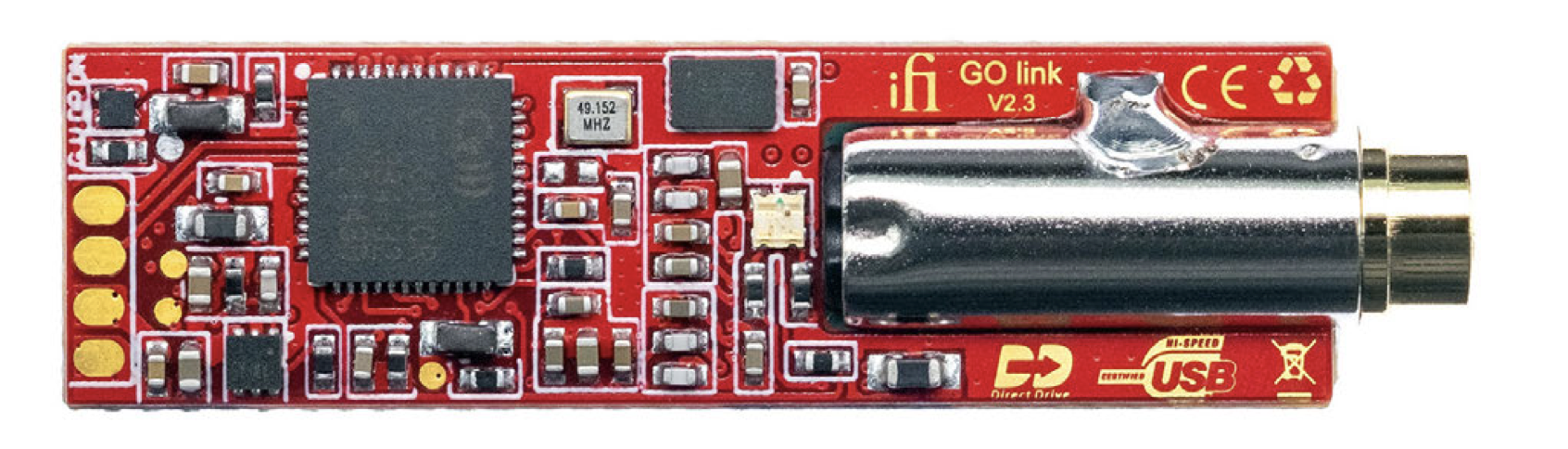
The conversion is handled by the ES9219MQ/Q circuit, which enables the device to support PCM playback in 32-bit and 384-kHz quality, DSD at 11.2 megahertz quality, and additionally dxd and mqa.
The Go Link, which fits in a pocket, is the smallest and most affordable iFin audio amplifier/DAC among the products. The compactness is further emphasized by the fact that the headphone and USB connectors are separate from each other, and there is a braided cable between them. In addition to the device itself, the package includes an USB-A adapter and, for Apple device users, a Lightning adapter. The USB connector is attached to a thick casing, so the phone’s protective case may have to be removed in some cases. However, this was not a problem with the silicone case for the Xiaomi Redmi Note 9.
The device is connected to the phone via USB-C, and there is a 3.5mm connection for headphones. Despite its small size, the device is capable of 32-bit and 384-kilohertz PCM audio playback, as well as DSD256 and DXD384 playback. MQA playback is also supported, which is used, for example, in the best Masters quality of the Tidal streaming service. The conversion is handled by the ES9219MQ/Q circuit.
Time Domain Jitter Eliminator technology is said to reduce jitter, or the irregular nature of the digital signal. The result should be less distortion, clearer sound, and a wider dynamic range. The signal noise ratio is said to be at least 125 dBA and the dynamic range at least 122 dB(A), which are both high numbers. The total harmonic distortion is said to be less than 0.004 percent, which is also a good figure.
There are no buttons or touch controls on the device. It is therefore extremely simple. Volume control is done using the computer or phone’s own controls, as is answering calls or controlling playback. The indicator LED shows the audio signal that is being played at any given time. The green light flashes when the PCM signal is played at 44.1–96 kHz sampling frequency, the yellow one at 176.4–384 kHz quality, the cyan one for DSD64 and DSD128 playback, the blue one for DSD256 playback, and the magenta one for MQA playback. The device played back high resolution and MQA files during the test, as it should.
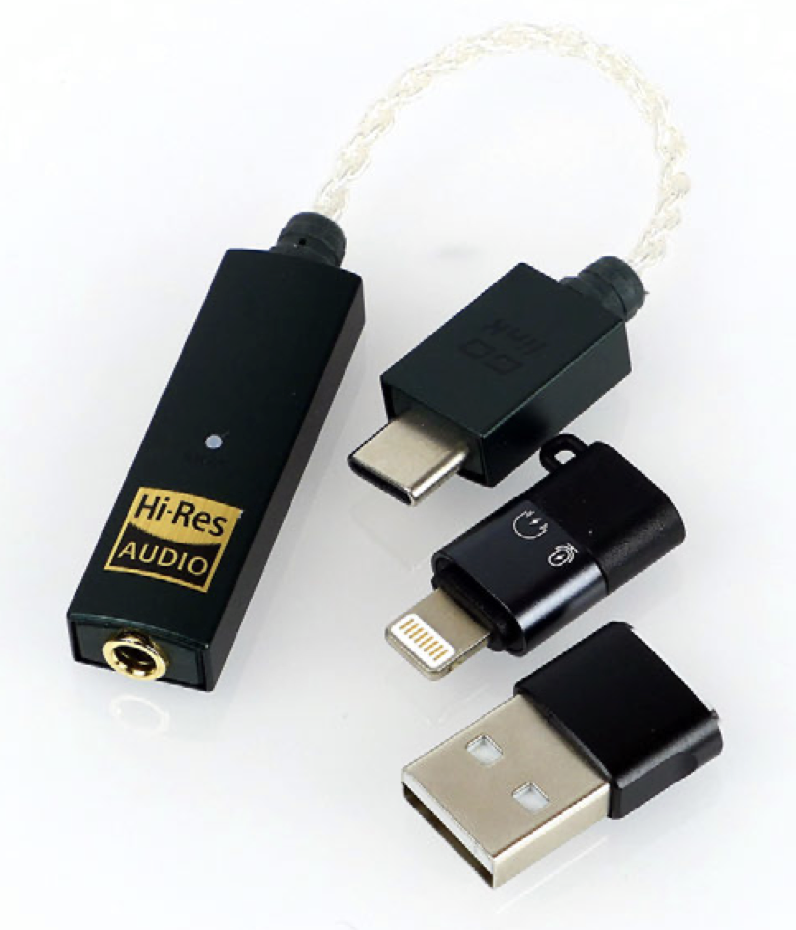
The affordable and small headphone amplifier/dac comes with accessories sufficient for most usage needs, namely a Lightning adapter for Apple devices and a USB-A adapter for almost any computer. The device itself has a USB-C port.
When you connect the device to the phone and open the music app, the phone asks if you want to allow the device to be used. After that, it should work. The device was tested on four Android phones, an iPhone, and on PC and Mac computers. The other devices tested worked, but not the Xiaomi phone. Despite investigating the reason, it still remains somewhat unclear, but it’s worth at least Googling your own phone if the OTG feature isn’t already part of your daily routine.
With the help of the dynamic Philips Fidelio X3 headphones, the volume could be kept at around half-way levels. Compared to the phone’s headphone output, the most noticeable difference is that the playback is somehow more effortless and smooth. The background is darker and more oppressive, so the details of the music itself and the more subtle dynamics become more clearly apparent. At the same time, the sound gained a hint of three-dimensionality.
When the headphones were tested with the more demanding load of the Yamaha HP-50S planar headphones, the difference compared to the phone’s own headphone jack was significant. The 150-ohm headphones are quite heavy, and in addition, they are not very sensitive. While when playing back audio through the phone’s own headphone jack, one had to turn up the volume to even reach a moderate listening volume, the Go Link gave the volume control about a quarter more leeway. Although the improvement was significant, there was still a sense that more power would have been needed for these heavy headphones to deliver all the enjoyment they had to offer.
The manufacturer states that the headphones have a 1.5 volt/70 milliwatt output with a 32 ohm load and a 2 volt/14 milliwatt output with a 300 ohm load. At higher impedances, the power is already quite low, so the maximum output from the headphone amplifier is limited to reasonably mobile headphones.
Most read today

Latest
Subscribe to the newsletter
Subscribe to our newsletter and stay up to date with the latest news in technology and entertainment electronics.
Survey
Quiz
Nokia phones
Related Posts
Cayin Jazz 70 – genuine tube sound and style at a reasonable price
The tube amplifier doesn't need to cost several thousand euros. The new Jazz 70 from Cayin brings classic EL34 tube technology, visible tubes, analog meters, and hand-crafted controls...

The use of artificial intelligence in music is growing rapidly, but there is still a lot to be learned about its use – at least in Finland.
Artificial music evokes significantly more reservations in Finns than the use of artificial intelligence in general. Artificial intelligence is rapidly becoming a part of everyday life, but the output it produces...
The new arrival of CDs is also reflected in devices – the Argon Audio CD1 is a new CD player priced at 399 euros
The arrival of vinyl records has been ongoing for a long time, and now a similar trend is also evident in CD records. Argon Audio responds to this interest with the new CD1 player,...

Audio-Technica ATH-AL5NC combines an open design and wireless connectivity – battery life up to 75 hours
Audio-Technica expands its range of open headphones with the ATH-AL5NC model, which is the manufacturer's first wireless open headphone. In addition to Bluetooth connectivity, it also features LDAC, noise reduction, and sound leakage...
The Marantz MCR 60n combines CD, vinyl, streaming, and TV audio into one device
Marantz has introduced the new MCR 60 multi-functional device, which continues the manufacturer's long series of compact Melody systems. A web player, CD player, and...

IN THE TEST: TCL 65C7L – Bright Mini LED with Wide Color Reproduction
TCL has invested heavily in Mini LED TVs in recent years and has also brought high brightness, rich local contrast, and comprehensive gaming features to clearly...
 Suomi
Suomi  English